
Victims’ Commissioner responds to HM Inspectorate of Probation public protection report ahead of further early releases
Published:
The Victims’ Commissioner for England and Wales, Claire Waxman OBE, has responded to the publication of a national report by Martin Jones, Chief Inspector of Probation, which identified continuing concerns around workforce pressures, information-sharing and risk management across probation services in England and Wales.
This report comes ahead of the first tranche of early releases, which are set to commence from 1 October 2026.
Claire Waxman OBE, Victims’ Commissioner for England and Wales, said:
Probation staff work incredibly hard to keep the public safe in some of the most challenging circumstances.
Those pressures are set to become considerably greater from 1 October, as the number of offenders managed in the community is set to surge following the next tranche of early releases.
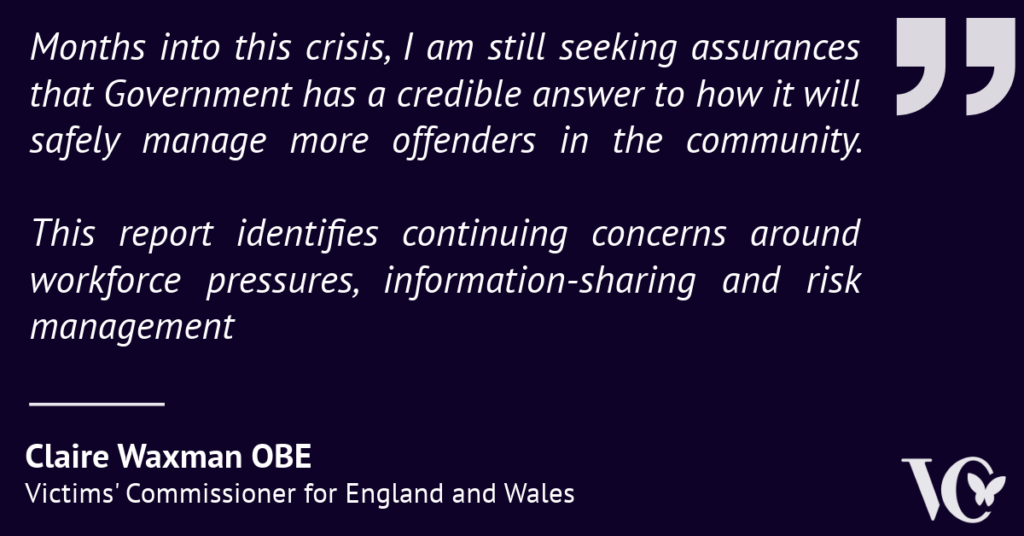
Months into this crisis, I am still seeking assurances that Government has a credible answer to how it will safely manage more offenders in the community. This report identifies continuing concerns around workforce pressures, information-sharing and risk management, raising serious questions about whether the agencies responsible for protecting the public have what they need to keep people safe.
What started as a prison capacity crisis now risks becoming a public safety challenge. This is not a challenge that probation can solve alone.
Victims need confidence that the agencies responsible for protecting the public have what they need to keep people safe. As Victims’ Commissioner, I will continue pressing Government for a credible strategy to strengthen the criminal justice system as a whole.
Those pressures are set to become considerably greater from 1 October, as the number of offenders managed in the community is set to surge following the next tranche of early releases.
Months into this crisis, I am still seeking assurances that Government has a credible answer to how it will safely manage more offenders in the community. This report identifies continuing concerns around workforce pressures, information-sharing and risk management, raising serious questions about whether the agencies responsible for protecting the public have what they need to keep people safe.
What started as a prison capacity crisis now risks becoming a public safety challenge. This is not a challenge that probation can solve alone.
Victims need confidence that the agencies responsible for protecting the public have what they need to keep people safe. As Victims’ Commissioner, I will continue pressing Government for a credible strategy to strengthen the criminal justice system as a whole.
Martin Jones, Chief Inspector of Probation, said:
Frontline probation staff are working hard to keep communities safe, often in very difficult circumstances. However, public protection work was not being delivered consistently well enough to provide the assurance that victims, communities and partner agencies were entitled to expect.
Persistent staffing shortages and workforce instability, combined with inconsistent information-sharing with the police and children’s services, meant that practitioners did not always have what they needed to identify, understand and manage risk effectively. As a result, opportunities to recognise patterns of harmful behaviour, safeguard children, protect victims and respond to escalating concerns were too often missed.
Persistent staffing shortages and workforce instability, combined with inconsistent information-sharing with the police and children’s services, meant that practitioners did not always have what they needed to identify, understand and manage risk effectively. As a result, opportunities to recognise patterns of harmful behaviour, safeguard children, protect victims and respond to escalating concerns were too often missed.