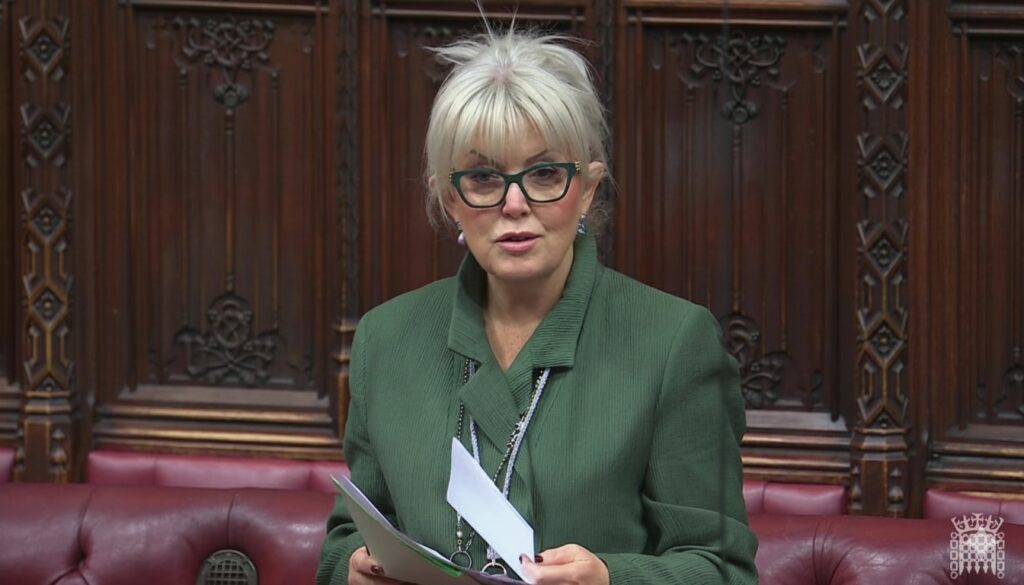
Baroness Helen Newlove, Victims’ Commissioner for England and Wales, died on 11 November following a short illness.
Helen was a committed and passionate advocate for victims, drawing as she did on her own experience of the criminal justice system. She channelled her personal pain into a life of service, dedicated to ensuring victims received a fair hearing and the justice they deserved.
Helen first came to national prominence in 2007 following the tragic and senseless murder of her husband, Garry Newlove, who was attacked by a gang of youths outside their home. Following this devastating loss, Helen became a dedicated community campaigner and prominent national voice, launching a tireless campaign to call on authorities to take action against persistent anti-social behaviour and youth violence.
In recognition of her extraordinary campaigning and achievements, Helen was appointed Government Champion for Active, Safer Communities in 2010. That same year, she was nominated for a peerage by then Prime Minister David Cameron. She subsequently served two terms as the Victims’ Commissioner for England and Wales: initially from 2013 to 2019, and a third term from 2023. She was due to retire on 31 December 2025.
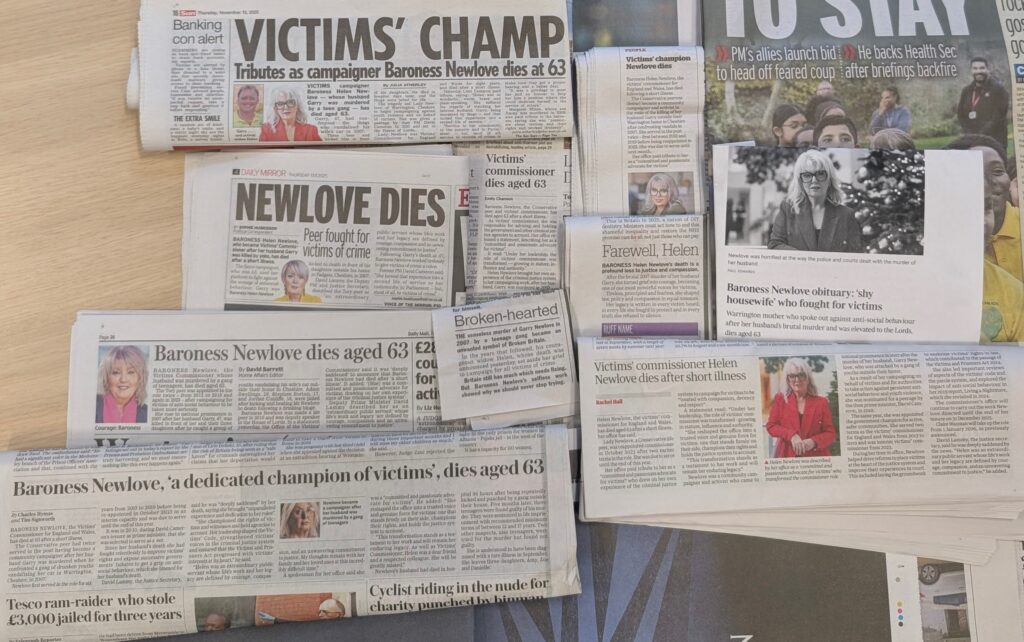
Helen’s approach was profoundly shaped by her and her family’s personal experiences of the criminal justice system. She wanted to improve victims’ experiences in court and ensure they were granted a meaningful voice throughout the criminal justice process. But above all, she was determined that victims should be treated with compassion, decency, and respect – qualities that defined both her tenure as Victims’ Commissioner and her own down-to-earth character.
Helen was instrumental in driving reforms to place victims at the heart of the justice system. She laid crucial groundwork to enshrine victims’ rights in law, a vision that contributed to the passage of the landmark Victims and Prisoners Act (2024).
She led important reviews of the Victims’ Code and the parole system, but perhaps most significantly, she secured a new law forcing the system to report, every year, on whether agencies are actually delivering the support victims are promised. Too often, agencies fail to uphold rights with no consequences. Helen changed that, ensuring that victims’ rights are not just words on a page, but a reality that is checked and enforced.
Helen was always focused on the needs of the most vulnerable victims. Just two months before her death, she gave evidence to the Justice Select Committee, arguing that victims of sexual violence should be allowed to pre-record their testimony to spare them the distress of a live courtroom. She fought for children and vulnerable victims to have better access to Registered Intermediaries, so that they could give best evidence, and she secured vital right for victims to make impact statements when offenders are detained under the Mental Health Act. Throughout it all, she never stopped spotlighting the severe, often overlooked, impact of persistent anti-social behaviour on victims, a subject close to her heart.
One of her proudest moments was when she successfully tabled an amendment to criminalise the abusive sexual practice of ‘non-fatal strangulation’ during the passage of the Domestic Abuse Act. This is a change that has undoubtedly saved and changed the lives of victims and survivors of domestic abuse.
As Commissioner, Helen placed great value on listening to victims and hearing about their lived experiences. She insisted on meeting many victims face-to-face during her time in office and always approached every conversation with immense care and sensitivity. She would be enraged by accounts of injustice and poor treatment and her sympathy for their pain and suffering was heartfelt. Meetings often ended in a hug, as only Helen could.
These meetings and first-hand accounts of victim experiences made a lasting mark on her, shaping her thinking and her priorities, and she would often refer to them in speeches and in meetings to highlight the need for change.
It was with this in mind, that her team undertook a number of victim surveys. In October, she published the largest victim survey ever produced by the office, capturing the voices and experiences of over 6,500 victims. Helen believed these surveys were instrumental in giving victims a voice – a mission she was determined to fulfil.
Some of her last meetings as Commissioner were with former sub-postmasters, whose stories stuck with her. It was fitting then that her final public intervention voiced her fury on their behalf – fighting, until the very end, for those who felt the system was still failing them.
Over the past two decades, Helen was a passionate advocate on behalf of all victims of crime and she leaves an impressive legacy. Above all, her team will always remember her as a warm, caring and compassionate colleague and a very dear friend.
Russell A’Court
Chief Executive Officer – Office of the Victims’ Commissioner (2016-2021 and 2023-2025)