
Letter to the Chair of the Courts and Tribunals Bill Committee, Sir John Hayes
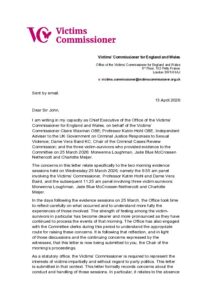
The Chief Executive of the Office of the Victims’ Commissioner, Susannah Hancock, wrote to the Chair of the Public Bill Committee on the Courts and Tribunals Bill to formally raise concerns about conduct during the Committee’s evidence session on 25 March 2026.
The letter raised concerns about the conduct and handling of the Public Bill Committee’s evidence sessions on 25 March 2026, particularly the lack of safeguarding and trauma‑informed support for victim‑survivors present. It invited Parliament to reflect on whether the session met its own standards for oral evidence and to consider what changes are needed to ensure that vulnerable witnesses can give evidence safely and with dignity in future.
The letter was submitted on behalf of the Victims’ Commissioner for England and Wales, Claire Waxman OBE; Professor Katrin Hohl OBE, Independent Adviser to the UK Government on Criminal Justice Responses to Sexual Violence; Dame Vera Baird KC, Chair of the Criminal Cases Review Commission; and the three victim‑survivors who gave evidence to the Committee that day — Morwenna Loughman, Jade Blue McCrossen‑Nethercott and Charlotte Meijer.
- A copy of this 13 April letter was published on the Parliamentary website on 21 April 2026.
- A letter from the Chairman of Ways and Means in response to a letter from the Victims Commissioner was published on the Parliamentary website on 21 April 2026.
- See exclusive coverage in the Guardian.
Letter to Sir John Hayes, Chair of the Public Bill Committee
13 April 2026
Dear Sir John,
I am writing in my capacity as Chief Executive of the Office of the Victims’ Commissioner for England and Wales, on behalf of the Victims’ Commissioner Claire Waxman OBE; Professor Katrin Hohl OBE, Independent Adviser to the UK Government on Criminal Justice Responses to Sexual Violence; Dame Vera Baird KC, Chair of the Criminal Cases Review Commission; and the three victim-survivors who provided evidence to the Committee on 25 March 2026: Morwenna Loughman, Jade Blue McCrossen Nethercott and Charlotte Meijer.
The concerns in this letter relate specifically to the two morning evidence sessions held on Wednesday 25 March 2026, namely the 9.55 am panel involving the Victims’ Commissioner, Professor Katrin Hohl and Dame Vera Baird, and the subsequent 11.25 am panel involving three victim-survivors: Morwenna Loughman, Jade Blue McCrossen Nethercott and Charlotte Meijer.
In the days following the evidence sessions on 25 March, the Office took time to reflect carefully on what occurred and to understand more fully the experiences of those involved. The strength of feeling among the victim-survivors in particular has become clearer and more pronounced as they have continued to process the events of that morning. The Office has also engaged with the Committee clerks during this period to understand the appropriate route for raising these concerns. It is following that reflection, and in light of those discussions and the continuing concerns expressed by the witnesses, that this letter is now being submitted to you, the Chair of the morning’s proceedings.
As a statutory office, the Victims’ Commissioner is required to represent the interests of victims impartially and without regard to party politics. This letter is submitted in that context. This letter formally records concerns about the conduct and handling of those sessions. In particular, it relates to the absence of any safeguarding measures for the victim-survivors who were present throughout, the environment created in the room and the impact this had on their ability to participate safely. Parliament’s own expectations for oral evidence sessions require that witnesses, especially those with lived experience of serious violence, are supported to give their best evidence. In this instance, no trauma-informed preparation, support or debriefing was put in place, despite the presence of rape survivors, the nature of the subject matter under discussion, and the foreseeable risks associated with such an environment
The Office recognises the important role that robust parliamentary scrutiny plays in shaping legislation and strengthening the justice system. The expert witnesses who appeared at 9.55am are fully accustomed to such scrutiny. However, several aspects of the tone and conduct during that session caused serious concern. Witnesses noted exchanges that were unnecessarily adversarial, with answers repeatedly interrupted or cut short, and questioning that at times resembled courtroom cross-examination rather than a parliamentary evidence session. They also observed visible signs of frustration among some Members, including gesticulating, audible chatter while witnesses were speaking, and a demeanour perceived as dismissive or derisive. It was felt the interventions you made as Chair did not prevent the tone from escalating or provide reassurance to those present.
These behaviours were inconsistent with the Committee’s own guidance on oral evidence sessions and out of keeping with the standards ordinarily expected in parliamentary scrutiny. This was also not in keeping with the other evidence sessions that day where no other witnesses experienced similar treatment.
This atmosphere was allowed to develop despite the Committee’s clear awareness that three victim survivors were present in the room ahead of giving their own evidence. Although the Victims’ Commissioner reminded Members during the session (“Can I just remind you that we have victims in the room?”), no steps were taken to moderate the tone, acknowledge the sensitivities or introduce any safeguarding adjustment. The absence of any intervention significantly compounded the distress experienced by those who were shortly to give their own evidence and raised wider concerns about the message this may send to victims and survivors across the country.
The consequences were serious. Immediately after the 11.25 am session, one of the victim-survivors experienced a significant emotional and psychological reaction, breaking down in the Committee Room itself in full view of Members. She described the experience as traumatising and retraumatising, triggering PTSD symptoms associated with her previous cross-examination in court. Staff from the Commissioner’s Office supported her from the room.
The two other victim-survivors described entering their own evidence session in a state of heightened anxiety, fearing that they might be addressed in the same manner they had just witnessed. Their accounts are set out below.
The Office fully recognises that Members may disagree strongly with witnesses and that scrutiny will be challenging. However, Parliament’s own published guidance states that oral evidence sessions are intended to enable Members to examine witnesses and gather evidence to inform scrutiny of the Bill. Several witnesses felt that, at points, the tone and style of questioning departed from this purpose, reducing the clarity and value of the evidence the Committee was able to receive. This had consequences not only for the individuals affected, but for the quality of evidence received by the Committee.
Victim-survivors of serious violence, including rape and domestic abuse, often follow parliamentary proceedings closely when legislation directly affecting their access to justice is under consideration. The conduct observed on 25 March risks sending the message that Parliament may not be a safe or respectful environment for survivors to contribute their experiences.
The Victims’ Commissioner has a statutory duty to represent victims’ interests impartially. She feels she cannot, in good conscience, encourage victim-survivors to participate in evidence sessions conducted in a manner that may expose them to retraumatisation or emotional harm.
In light of the seriousness of what occurred, the Office respectfully asks the Committee to review:
- the conduct of the 9.55 am evidence session;
- the response to clear indications that vulnerable individuals were present;
- the absence of any safeguarding adjustments once that fact was known;
- the significant distress experienced by one survivor as a direct consequence; and
- whether the questioning and room management were consistent with the Committee’s own published guidance.
The Office also asks the Committee to consider what steps might be taken to prevent a recurrence, including clearer guidance for Chairs and Members on handling evidence sessions involving vulnerable witnesses, and ensuring that all participants can contribute safely and with dignity.
The Victims’ Commissioner, Dame Vera Baird and Professor Katrin Hohl endorse this letter because they value Parliament as a place where victims should be able to contribute safely, confidently and without fear of retraumatisation. Each respectfully asks the Committee to consider the issues raised so that future evidence sessions involving vulnerable people can be conducted in a way that upholds the dignity and wellbeing of all participants and enables all witnesses to participate fully and safely.
I would be grateful if the Committee could confirm receipt of this letter and outline the next steps for how these concerns will be considered.
Yours sincerely,
Susannah Hancock
Chief Executive Officer, Victims’ Commissioner for England and Wales
Morwenna Loughman:
“I was shocked, upset and extremely distressed to witness the behaviour towards Claire, Katrin and Vera yesterday – Claire especially; it crossed the line into disrespect and pugnaciousness. As a victim-survivor I immediately felt threatened and attacked, thrust back into fight or flight. His attitude played a large part in my breaking down, sobbing and struggling to breathe after questioning.”
Jade Blue McCrossen-Nethercott:
“Yesterday was difficult to watch. There’s a line between scrutiny and cross-examination – at times, that line was crossed. With victims present and watching online, that’s not acceptable – it was disrespectful. Claire deserved better, and I support this being raised.”
Charlotte Meijer:
“Watching him attack Claire made me feel like I was back in court. Not being given the proper respect to finish your sentence or say what you want to say. It felt like he was trying to trip her up. In a situation that was already high stress for me, a victim, to repeat what happened to me, made me feel anxious for my panel, if he would try and do the same.”