
‘Funding is critical’: Victims’ Commissioner warns VAWG strategy risks becoming a ‘wish-list’ without investment
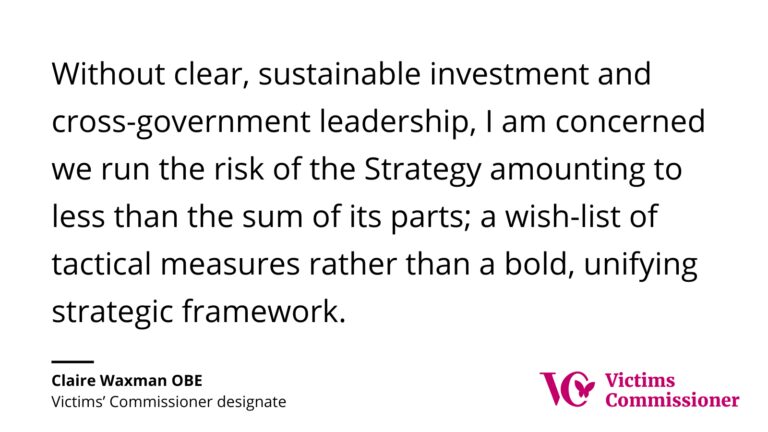
Despite several welcome initiatives, the incoming Victims' Commissioner warned the strategy risks amounting to "less than the sum of its parts" without significant new investment.
The government has published its long-awaited strategy to fulfil a flagship pledge: halving violence against women and girls (VAWG) within a decade.
The Victims’ Commissioner has responded to the landmark strategy, welcoming specific elements but warning that its success hinges on whether key delivery partners, including victim services, are properly funded.
Claire Waxman OBE, who formally takes up her post as Victims’ Commissioner in the new year, welcomed the wide-ranging nature of the cross-government strategy. However, she cautioned that “early indications around funding are deeply concerning,” warning that insufficient investment risks leaving the strategy as little more than a “wish-list.”
The strategy, published on 18 December, includes several key measures that have long been campaigned for by the Victims’ Commissioner designate, including:
- The ‘Child House’ model: a national rollout of a support system for child abuse victims (pioneered by Lighthouse in London) which provides medical, social, and police support under one roof to reduce trauma.
- Operation Soteria: an evidence-based programme designed to transform the response to serious sexual offences, will now be expanded to criminal courts to help prevent the re-traumatisation of victims
Despite these steps, the Commissioner’s response highlights a “deeply concerning” financial outlook. On 2 December, the Ministry of Justice announced £550 million over three years for specialist services. However, while the government announced a 2% increase year-on-year, inflation currently stands at 3.2%.
Coupled with recent increases to the national living wage and Employer National Insurance Contributions, there is significant concern that this signifies a real-terms cut in funding.
Furthermore, the 2025–26 funding settlement froze domestic abuse and sexual violence services at 2024-25 levels, while core funding for Police and Crime Commissioners (PCCs) was reduced by 4.2%.
These concerns were reflected by Claire Waxman’s predecessor, Baroness Newlove. In June 2025, the then Victims’ Commissioner, Baroness Newlove and Domestic Abuse Commissioner, Nicole Jacobs, wrote to the Prime Minister warning he was at risk of missing his flagship target to halve violence against women and girls – unless urgent investment was made available for victim support services.
In her statement, Claire Waxman warned that the strategy will naturally drive up demand through new measures in schools and the NHS. “Driving up demand without increasing capacity puts victims at risk and threatens to destabilise the very partners the Strategy relies upon,” she said.
“Victim services are not an optional extra to this strategy – they must be the backbone of it.”
Claire Waxman OBE, the Victims’ Commissioner designate said:
“As the government rightly states, this is a national emergency – and it requires a commensurate response. The government’s new VAWG Strategy is welcome in its wide-ranging nature, containing a raft of announcements spanning justice, education, health, and beyond.
“As incoming Victims’ Commissioner, my focus is on practical measures that deliver real change, ensuring victims can access the justice and support they need. While many individual initiatives are welcome, it remains to be seen whether the overall Strategy provides the scale, pace, and leadership required to match the government’s ambition – and truly tackle this emergency.
“In terms of specific measures, the national rollout of the Child House model – pioneered by Lighthouse in London – is a welcome step I have long called for. It marks vital progress towards delivering on the recommendations of the Independent Inquiry into Child Sexual Abuse. I also welcome initiatives such as the expansion of Operation Soteria to reduce the re-traumatisation too many victims experience in the trial process. Long after my 2019 London Rape Review, ‘end-to-end’ reform of the justice system for serious sexual offences is finally in sight – but only if the government now delivers on its commitment to Independent Legal Advice for rape survivors, and tackles the long waits for justice.
“Ultimately, the success of this Strategy hinges on whether delivery partners are equipped to succeed. Early indications around funding are deeply concerning. The Strategy introduces welcome measures in schools and the NHS which will, by design, drive up disclosures and referrals to police and victim services. Yet frontline services are already overstretched and struggling to meet need, and the criminal justice system remains in crisis.
“Funding is critical. Driving up demand without increasing capacity puts victims at risk and threatens to destabilise the very partners the Strategy relies upon. This concern is heightened by the lack of meaningful consultation. Victim services are not an optional extra to this Strategy – they must be the backbone of it.
“Without clear, sustainable investment and cross-government leadership, I am concerned we run the risk of the Strategy amounting to less than the sum of its parts; a wish-list of tactical measures rather than a bold, unifying strategic framework.
“The Sentencing Bill underlines this lack of cohesion. Victims need confidence that the system will protect them, yet under the proposals in the Bill, the reality is that many abusers will avoid prison entirely or benefit from early release – undermining the very safety this Strategy seeks to guarantee.
“A commitment to halve violence against women and girls is not just a political pledge; it is a moral imperative grounded in the scale of harm being inflicted every day on women and children across the country. Such a national mission demands leadership from the very top. Number 10 must play a central role in driving this agenda – and ensuring it is funded appropriately.
“Delivery is now key. My office will be scrutinising the implementation closely – including the data underpinning these commitments – and I am committed to working with the government to ensure the Strategy translates into real-world change, where women and girls feel safe, supported, and protected.”
- See the government’s violence against women and girls (VAWG) strategy and association action plan (published 18 December).
- The late Victims’ Commissioner, Baroness Newlove, set out six foundational principles that she felt must underpin the VAWG Strategy.