
Our justice system is too broken to deliver on its promises
In 2026, victims have more rights than ever but accessing justice has never been harder.
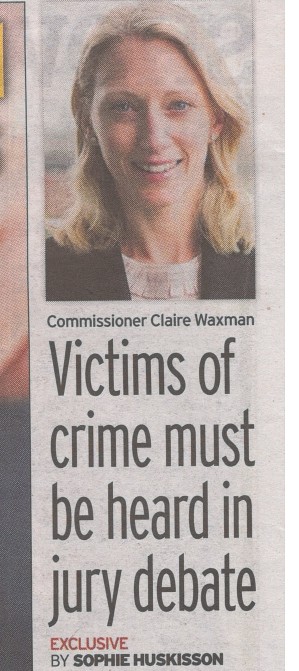
This article was first published in The Daily Mirror on 8 January 2026, alongside a news article.
As a victim of persistent stalking spanning two decades, I know the pain of being failed by the system meant to keep you safe.
That experience shaped my life and career. It drove me to dedicate years to championing victims’ voices – fighting for landmark changes like the Victims and Prisoners Act. These were vital, hard-won victories that finally enshrined victims’ rights in law.
But as I step into my new role as Victims’ Commissioner, I know that rights on a page are not enough. A law can promise access to justice and support, but only a functioning court system can deliver it.
For most people, the expectation is simple: you suffer a crime, you report it, and the system steps in. You expect a process that is swift, fair, and supportive.
The reality in 2026 is a shock to the system. To be a victim today is to discover that the moment you report a crime, you are effectively entering a waiting room – a holding pen that only deepens your anxiety and trauma.
You might assume that because you are the victim, you are the most important person in the case. Yet in a system overwhelmed by demand, too often you become a bystander to your own case. You wait months for updates that never come. And while specialist support services do incredible, heroic work to hold victims together, they cannot substitute for a court date that never arrives.
I have sat with victims facing trial dates listed as late as 2030. It is not just the agonising wait that victims endure; it is the constant drumbeat of uncertainty, adjourned hearings, and the inability to recover from their trauma because the process simply won’t let them.
With the Sentencing Bill set to cut jail time even further, victims waiting years for their day in court might be forgiven for asking if it is they who are serving the sentence, not the offender.
The result is heartbreakingly predictable. Victims walk away because they find they physically and emotionally cannot sustain the wait. The price of justice – years of their life on hold – is simply too high.
As London’s Victims’ Commissioner, I warned that years of underfunding and neglect were pushing the system to breaking point. We are now living with the fallout. The backlog has reached nearly 80,000 cases – double the pre-pandemic figure. That is 80,000 lives on hold.
Many crimes dating back to the last decade still await trial. Children have become adults and lives have been irrevocably changed, all while waiting for a day in court. Without intervention, projections suggest a backlog of 125,000 cases by the end of this Parliament – a monstrous dereliction of duty.
The sheer scale of the challenge means that ‘business as usual’ is no longer an option.
Sir Brian Leveson was asked to examine the court system. His verdict? The system is so broken that tinkering around the edges will not suffice. You cannot just turn on the funding taps and hope for the best; we are past the point of sticking plasters.
In response, the government has proposed radical changes, including the potential use of judge-only trials to bypass the gridlock. I know these proposals challenge long-held traditions and they will be fiercely debated. That is only right.
But we must all face a hard truth: our court system has been turned into an endurance test that breaks the very people it is meant to serve. A system that forces a rape survivor to wait five or more years for their chance at justice is not working. This is justice in name only.
The status quo is untenable and every day we hesitate, the queue grows longer, and more victims walk away – leaving offenders to act with impunity.
We must finally turn the tide on this crisis.
In the coming months, we will hear much about legal precedent and courtroom mechanics. My job is to ensure the victim’s voice is not lost in important debates about tradition and process.
I will scrutinise every proposal through a single lens: does it deliver swift and effective justice for those harmed by crime? Because there is a human cost to this crisis. If the journey to the courtroom breaks the victim, the system has failed.
We must stop asking the impossible of victims and start delivering a system in which they can place their trust – one that works well in practice, not just in theory.