
“Justice is not being served” – Commissioner urges urgent wholesale reform in wake of Leveson Report
Victims’ Commissioner warns that efficiency measures alone cannot fix a system at a "tipping point," calling for urgent and bold reform of the court system.
Part Two of Sir Brian Leveson’s Independent Review of the Criminal Courts has now been published. While the Review outlines over 130 recommendations to rescue a system “on the brink of collapse,” Victims’ Commissioner Claire Waxman OBE warns that efficiency alone will not fix a system that is failing victims.
The second and final part of Sir Brian Leveson’s landmark review proposes a sweeping overhaul of the operational inefficiencies currently leaving victims waiting years for justice.
Sir Brian concludes that while operational improvements are vital, they are not a “silver bullet.” Instead, he calls for a wholesale package of structural reform, additional funding, and a raft of efficiency measures to pull the justice system back from the brink of total failure.
Responding to the findings, Victims’ Commissioner Claire Waxman OBE issued a direct and stark challenge to the Government and Parliament, questioning the very viability of the current process:
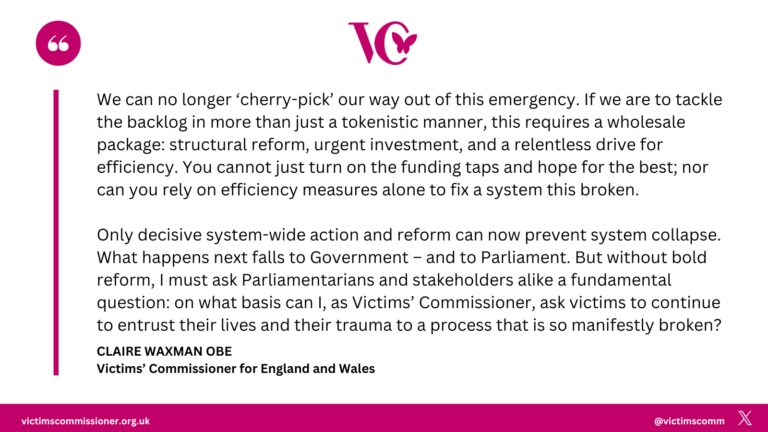
“Only decisive system-wide action and reform can now prevent system collapse. What happens next falls to Government – and to Parliament. But without bold reform, I must ask Parliamentarians and stakeholders alike a fundamental question: on what basis can I, as Victims’ Commissioner, ask victims to continue to entrust their lives and their trauma to a process that is so manifestly broken?”
The Commissioner warned that the current state of the courts is actively harming those it is meant to protect. “For victims, justice is not being served—at best it is being endured; at worst, it is breaking them,” she stated. “We are seeing vulnerable children grow into adults while awaiting a trial date that never comes, and survivors forced to abandon justice because they simply cannot sit with their trauma any longer.”
The Commissioner argued that the time for “tokenistic” fixes has passed. To prevent a total system collapse, she is calling for a “wholesale package” of reform:
“We can no longer ‘cherry-pick’ our way out of this emergency. If we are to tackle the backlog in more than just a tokenistic manner, this requires a wholesale package: structural reform, urgent investment, and a relentless drive for efficiency. You cannot just turn on the funding taps and hope for the best; nor can you rely on efficiency measures alone to fix a system this broken.”
Key recommendations from the Review welcomed by the Commissioner include:
- A Prime Minister’s Criminal Justice Adviser: A new central role to coordinate leadership across the Home Office, Ministry of Justice, and Attorney General’s Office.
- Technological innovation: The use of AI for smarter case listing and the expansion of remote hearings to reduce the burden on victims and witnesses.
- Open justice: Long-standing calls to record proceedings in the Magistrates’ Court to ensure accountability and transparency.
However, the Commissioner emphasised that court reform is only one piece of the puzzle when it comes to poor victim experiences. She noted that the “constant drumbeat of uncertainty” and poor communication from the Police and CPS are as damaging as the court delays themselves.
“Reform of our courts must be complemented by concerted action to tackle these poor victim experiences, or we risk playing ‘whack-a-mole’, veering from crisis to crisis,” Waxman stated.
She concluded by calling for sustainable funding for victim services, describing them as the “best bet for keeping victims engaged in a system crippled by delays”.
Full statement: Claire Waxman OBE
“For victims, justice is not being served – at best it is being endured; at worst, it is breaking them. We are seeing vulnerable children grow into adults while awaiting a trial date that never comes, and survivors forced to abandon justice because they simply cannot sit with their trauma any longer.
“Sir Brian Leveson’s report makes it clear: our justice system is standing on the brink of disaster. I am similarly clear: we are at a tipping point. If we do nothing, or not enough, more victims will give up and more cases will collapse. Offenders will be granted a licence to act with impunity, leaving the public at risk.
“We can no longer ‘cherry-pick’ our way out of this emergency. If we are to tackle the backlog in more than just a tokenistic manner, this requires a wholesale package: structural reform, urgent investment, and a relentless drive for efficiency. You cannot just turn on the funding taps and hope for the best; nor can you rely on efficiency measures alone to fix a system this broken.
“Only decisive system-wide action and reform can now prevent system collapse. What happens next falls to Government – and to Parliament. But without bold reform, I must ask Parliamentarians and stakeholders alike a fundamental question: on what basis can I, as Victims’ Commissioner, ask victims to continue to entrust their lives and their trauma to a process that is so manifestly broken?
Leadership and investment:
“For too long, the criminal justice system has been mismanaged and operated in siloes, leaving victims to fall through the cracks of fragmented systems and leadership at cross-purposes. I strongly welcome the appointment of a Criminal Justice Adviser to the Prime Minister – a central role that must finally bring the justice system out of austerity and out from the political shadows.
“We must face the reality that a modern justice system cannot be run on a shoe-string budget. Efficiency measures are bound to fail if they are not backed by the investment needed to address the chronic underfunding at the root of this collapse. You cannot put a price on public safety, and this decades-long experiment proves justice cannot be delivered on the cheap.
A more open, transparent and supportive system:
“A number of the Review’s recommendations reflect my long-standing calls to ensure open justice for those navigating our courts. I also welcome the move toward innovative technological solutions, whether the remote attendance of hearings, or the use of AI to create smarter, more reliable listing protocols.
“In the absence of a silver bullet, victim services are our best bet for keeping victims engaged in a system crippled by delays. They are essential to the recovery of the individual and the stability of the system itself; as such, they must be sustainably funded as part of any reform package.
“Crucially, it is not just the agonising wait that victims endure; it is the constant drumbeat of uncertainty, the cycle of adjourned hearings, and the inconsistent treatment and communication found across a fragmented justice system, from the police to the CPS and beyond. Reform of our courts must be complemented by concerted action to tackle these poor victim experiences, or we risk playing ‘whack-a-mole’, veering from crisis to crisis in our justice system.”